
Abstract
Objective
To evaluate the effect of emotional states on reproducibilities of rest position, social and spontaneous smiles, and speech.
Methods
A total of 30 individuals aged 18-22 years were included (mean age; 19.03 years ±1.03). Three emotional states were determined: amusing, sadness, and neutral. The participants watched three different videos in 3 sessions on the same day. After each video, the participants completed a questionnaire to assess their mood. The rest position, social and spontaneous smiles, and speech recordings were gathered from the participants using videographic method. Measurements were made for each function. The Friedman test, One-Way ANOVA, Kruskal-Wallis test was performed for statistical evaluations, and intra-observer correlation coefficients and Bland-Altman Limits of Agreement were calculated.
Results
In spontaneous smiles, there were significant differences between amusing and sadness in the smile height (p=0.020); amusing and sadness in the lower lip thickness (p=0.029). In social smiles there was a significant difference between amusing and sadness in the maxillary incisor display (p=0.006). There were no statistically significant differences in the rest position, but clinically significant differences were observed in some participants. In speech, a significant difference was found between amusing and sadness in the distance between the upper lip and subnasal (p=0.035).
Conclusion
The reproducibility of social and spontaneous smiles was influenced by various emotional states. However, the rest position exhibits higher reproducibility than social and spontaneous smiles in all emotional states.
Keywords: Rest position, smile, speech, reproducibility, emotional state
Main Points
• The reproducibility of functions varies according to emotional states.
• Social and spontaneous smiles vary depending on the emotional state.
• The rest position was found to have the most reliable reproducibility compared with social and spontaneous smiles and speech.
• The reproducibility of functions is important in multidisciplinary treatment planning.
INTRODUCTION
In the modern orthodontic perspective, the examination of overall facial esthetics has become more important in diagnosis and treatment planning, because of the development of the soft tissue paradigm.In this regard, the number of studies evaluating soft tissue esthetics have recently been increasing. These studies are based on both objective data and subjective individual perceptions. Enhancing smile esthetics is an important factor for motivating patients to undergo orthodontic treatment. However, it is also believed that it is not always related to orthodontic diagnosis and treatment but is also associated with an individual’s emotional state.
Clinicians use diagnostic materials, including intraoral and extraoral images, to ensure the success of treatment planning or mechanics during the orthodontic treatment process. Because these records are taken at specific intervals within a particular time point during the treatment, the reproducibility of rest position, social and spontaneous smiles, and speech can play an important role in achieving esthetic treatment goals. During orthodontic treatment, clinicians need a reference point that can be considered constant. However, if the rest position, social and spontaneous smiles, and speech are affected by emotional states, identifying a dependable reference point becomes challenging In this case, differences not attributable to the treatment may be observed upon analysis of the records.Sarver and Ackerman used a social smile as a guide during the planning of hard and soft tissue facial treatment. They pointed out that the reproducibility of smile showed variability, and that the rest position had the highest reproducibility., Ekman suggested that social smile could be affected by a person’s social abilities and emotional background, leading to a smile that may be unnatural or asymmetrical. Zachrisson emphasized that a photograph taken directly from the frontal view while the patient is in the rest position provided one of the most important parts of information for planning, diagnosis, and treatment. Ackerman et al. reported that the reproducibility of smiles in children is uncertain. They noted that it was likely for adolescents to develop a maturation sequence in a reproducible smile.Burstone stated that the rest position has the highest reproducibility and that the appearance of maxillary incisors in the rest position would guide orthodontic treatment planning. Van der Geld et al. stated that a spontaneous smile can serve as a guide for evaluating the relationship between the lips and teeth.
If the emotional state of the patient affects the reproducibility of the above-mentioned functions, clinicians may find it challenging to determine the realization of the esthetic goals they have devised during recurring appointments, leading to potential unnecessary alterations in treatment objectives and, consequently, in treatment modalities. In such situations, clinicians can administer questionnaires to assess the patients’ current emotional state and, if necessary, guide patients toward their desired emotional state before taking the records or conducting clinical examinations. While many studies have examined the reproducibilities of rest position, social and spontaneous smiles, and speech; no studies have addressed the relationship between reproducibility and the individual’s emotional state. The aim of this study was to evaluate the effect of emotional states on the reproducibilities of rest position, social and spontaneous smiles, and speech. The study hypothesis was that the emotional state of the patient affected the reproducibility of rest position, social and spontaneous smiles, and speech.
METHODS
The study was approved by the Medical Research Ethics Committee of Ege University (approval no.: 22-4T/1, date: 12.04.2022). Participants were asked to fill out a signed consent form at the beginning of the study. The surveys of the study have been used in research conducted in the Clinical Psychology Department at Ege University and are highly validated.
As a result of the power analysis performed with the software program G*Power 3.1.9.2 (Franz Faul, UniversitätKiel, Germany), more than 80% power was obtained with an effect size of 0.8 and a significance level of α=0.05 with a sample size of 30 people.A total of 30 volunteers were included in the study, consisting of 15 females (mean age; 18.93 years ±1.03) and 15 males (mean age; 19.13 years ±1.06). The participants’ ages ranged from 18 to 22 years, with a mean age of 19.03 years ±1.03. The inclusion criteria were determined as; no active orthodontic treatment, no prominent scars in the head and neck region, no illness that would impair speech and smiling, and no prosthetic restorations within the smiling area.
Upon the participants’ initial arrival, a survey designed to assess their levels of positivity and excitement was administered at the start of the day. The survey was handed out to the participants in person. There were two questions in the survey. They were asked to score the questions, “Over the past few weeks, how negative or positive have you been feeling emotionally?” and “Over the past few weeks, how calm or excited have you been feeling emotionally?” on a scale from 1 to 9. The purpose of this survey was to determine the participants’ positivity and excitement levels at the beginning of the day.In terms of positivity, a score of (1-4) indicates negativity, and a score of (6-9) indicates positivity. In terms of excitement, a score of (1-4) indicates calmness, and a score of (6-9) indicates excited. A score of 5 is neutral.
Participants were informed about the process of video recording. No detailed information related to the purpose of the study was provided. Each participant was given three appointments in one day. During three different parts of the day-morning, noon, and afternoon-participants were shown videos in three varied themes: sadness, neutral, and amusing in an empty 8 m room with daylight, containing only one chair and a tripod in different order. Participants sat in a chair and watched approximately three-minute-long colored videos from a laptop provided to them, with the sound level set to conversational volume level. Video recordings of the participants were recorded immediately after they watched the videos.
The videos used in this study were taken from a stimulus set development study conducted by Amado et al. to evaluate the emotion induction levels of videos in the study group. One video from each category of amusing, sadness, and neutral emotions pertaining to the mentioned study was selected to be used in this study. When selecting the positive and negative videos, similarity criteria considered, which is included the absolute distances of the valence scores related to excitement levels, effectiveness in inducing the target emotions (such as amusing or sadness), and consistency in video durations. The neutral video was selected due to its duration being similar to that of the positive and negative videos.
Participants were recorded in rest position, during social and spontaneous smiles, and during speech under the same conditions. They were instructed to stand 15 cm away from the camera with a natural head position, to stand in a way that they felt comfortable, and to look at the camera with calibration glasses. The recordings were recorded using a digital camera. In the first step, they were asked to say word “Emma”, to capture the rest position. Then, a social smile was elicited with the command, “I want a big smile where I can see all your teeth”. This process was followed by the speech recordings, where the Turkish version of a sentence containing specific phonetics, which was determined in the literature, was utilized. To elicit spontaneous smiles, the participants were instructed to repeat their funny phrases immediately after a period of formal interaction, such as recording the rest position. This procedure was reported to be particularly effective for eliciting spontaneous smiles when funny sentences were made unexpectedly.
After recording the videos, participants were administered a survey in which they rated various emotions they were feeling at that moment on a scale of 1-9. This survey comprises 27 questions. Their positivity, excitement, and 20 different emotions were scored. The emotional levels recorded in these surveys after watching each emotional state video were compared.
The videos were uploaded to a MacOS-supported computer. Two hundred images were captured from each functional state in each video. From these 200 images, five that best reflect each function and have the optimal head position, image clarity, and distance to the camera were identified by three researchers. Subsequently, the image that best represented each function was selected by the consensus of two orthodontists with different levels of experience (14 years and 2 years). As a result, a total of four images were obtained after each emotional state: rest position, social and spontaneous smiles, and speech, making a total of 12 images per participant. During the measurements, a calibration eyeglass, which was worn by the participants during the video recording, was utilized. The length of the ruler was proportional to the parameters to be measured. Parameters measured in the rest position (), social smile (Figure 2), spontaneous smile (Figure 3), and speech (Figure 4) are shown in the images. The parameter explanations are presented in .
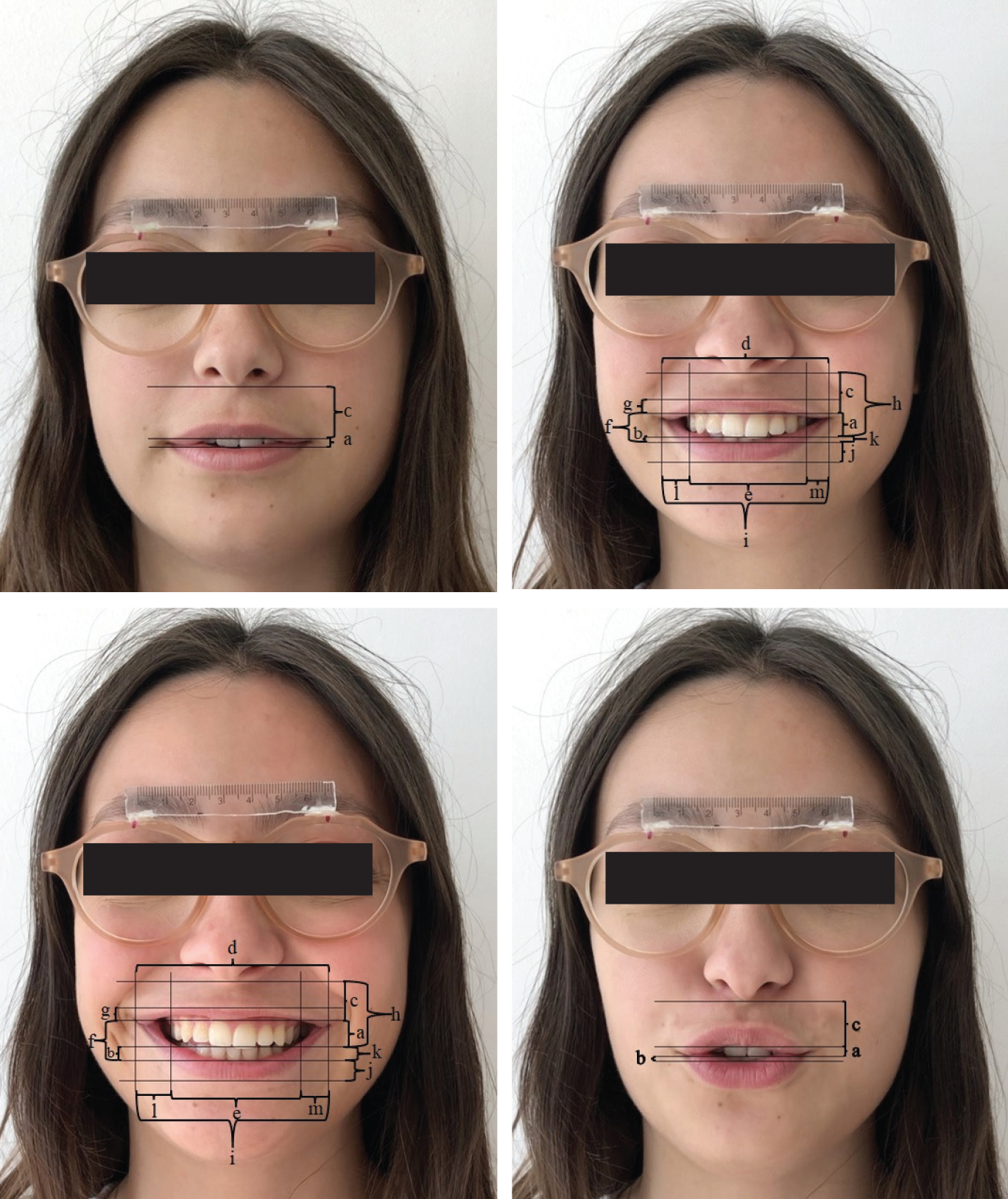
Table 1. Measurement definitions
Measurements | Description |
|---|---|
Maxillary incisor display | Volume of vertical display of the maxillary central incisors |
Mandibular incisor display | Vertical display of the mandibular central incisors |
Distance between the upper lip and subnasal layer | Distance from the subnasal to inferior border of the upper lip |
Smile width | Intercommissure width as measured by distance between left cheilion to right cheilion during smiling |
Visible dentition width | Distance from the most lateral aspect of the most visible maxillary posterior tooth on the right and left sides |
Smile height | Interlabial gap as measured by the distance from the upper to lower stomion during smiling |
Smile index | Smile width divided by smile height |
Upper lip thickness | Vertical distance from the deepest midline portion of the superior margin to the most inferior portion of the upper lip |
Distance between the subnasal and incisal edges of the maxillary central incisor | Distance from the subnasal to incisal edge of the maxillary central incisor |
Intercommissural width | Horizontal distance between the right and left inner commissures |
Lower lip thickness | Vertical distance from the deepest midline portion of the superior margin to the most inferior portion of the lower lip |
Lower lip to the maxillary incisor distance | Vertical distance from the incisal edge of the maxillary right central incisor to the deepest midline point on the superior margin of the lower lip. |
The buccal corridor right | Horizontal distance from the most lateral aspect of the posterior most visible tooth to the right inner commissure |
The buccal corridor left | Horizontal distance from the most lateral aspect of the left posterior visible tooth to the left inner commissure |
Buccal corridor total | The right and left buccal corridor sums |
With the permission of Dindaroğlu et al.
Statistical Analysis
The statistical analysis was conducted using the SPSS V.22 software (IBM SPSS Statistics; Armonk, NY, USA). The descriptive statistics of the data were calculated. The normality of the data was evaluated with Shapiro-Wilk test. The level of each emotional states after each video session were compared with Kruskall-Wallis test with Dunn post-hoc test for non-normally distributed data and One-Way ANOVA with Tukey post-hoc test for normally distributed data. Each parameter measured on the images was compared among the emotional states using Friedman’s two-way analysis of variance, and intraclass correlation coefficient (ICC) values were calculated using Spearman’s Correlation Analysis. Bland-Altman plots of upper and lower agreement levels were determined. Twenty images were randomly selected after one month from the first measurement, and all measurements were made again to evaluate the intra-observer reliability using the ICC. The level of significance was set as p<0.05.
RESULTS
The intraobserver reliability of the measurements was between 0.897 and 0.975. The mean positivity level of all participants in the experiment day just before the experiment was 5.6±1.82, while the mean excitement level was 5.83±1.7. The emotional states of the participants on the experiment day were determined to be neutral.
The descriptive statistics of the emotional state survey scores obtained from the participants after each video are presented in . After the amusing video, the scores for the positivity, happiness, and amusing conditions were significantly higher compared to the other video groups (p<0.001). Similarly, after the sadness video, the participants’ scores for unhappiness, anxiety, and sadness were significantly higher compared to other emotions (p<0.001).
Table 2. Descriptive statistics of the emotional state survey scores after each video
Emotional State | Video Type | Video Type | Mean Difference | Standard Error | p-value* |
|---|---|---|---|---|---|
Positivity | Amusing | Sadness | 4.2 | 0.364 | p<0.001 |
Amusing | Neutral | 2.8 | 0.364 | p<0.001 | |
Sadness | Neutral | -1.4 | 0.364 | p<0,001 | |
Happiness | Amusing | Sadness | 5.7 | 0.467 | p<0.001 |
Amusing | Neutral | 3.9 | 0.467 | p<0.001 | |
Sadness | Neutral | -1.8 | 0.467 | 0.001 | |
Unhappiness | Amusing | Sadness | -5.1 | 0.511 | p<0.001 |
Amusing | Neutral | -2.6 | 0.511 | p<0.001 | |
Sadness | Neutral | 2.5 | 0.511 | p<0.001 | |
Anxiety | Amusing | Sadness | -4.6 | 0.642 | p<0.001 |
Amusing | Neutral | -2.4 | 0.642 | 0.001 | |
Sadness | Neutral | 2.2 | 0.642 | 0.003 | |
Sadness | Amusing | Sadness | -6.0 | 0.465 | p<0.001 |
Amusing | Neutral | -2.3 | 0.465 | p<0.001 | |
Sadness | Neutral | 3.7 | 0.465 | p<0.001 | |
Amusing | Amusing | Sadness | 5.9 | 0.313 | p<0.001 |
Amusing | Neutral | 5.5 | 0.313 | p<0.001 | |
Sadness | Neutral | -0.4 | 0.313 | 0.412 |
*Kruskall-Wallis test with Dunn post-hoc and One-Way ANOVA with Tukey post-hoc
The statistical significance level was p<0.05
For the rest position, all differences between various emotional states were not statistically significant for all parameters, and mean differences were less than 1 mm. The highest difference was between sadness and neutral states for the distance between upper lip and subnasal. The correlation values between the measurements were 0.598 and 0.913. The highest correlation was in the distance between upper lip and subnasal parameters of amusing and sadness, while the lowest correlation was observed in the mandibular incisor display. According to Bland Altman plot, the agreement limits exceeded 2 mm for all parameters in some cases, and particularly for the distance between the upper lip and subnasal, the limits increased for the difference between amusing and sadness videos compared to neutral videos ().
Table 3. Statistical comparison of rest position parameters between different emotional states
Agreement Limits of Bland-Altman Plots | ||||||||
|---|---|---|---|---|---|---|---|---|
p-value* | Mean difference | 95% Confidence interval | p-value* | Upper limit (95% CI) | Lower limit (95% CI) | ICC values^ | ||
Maxillary incisor display | 0.134 | Amusing-Sadness | 0.26 | (-0.15; 0.67) | NS | 2.42 (1.71; 3.14) | -1.90 (-2.62; -1.19) | 0.867 |
Amusing-Neutral | 0.31 | (-0.04; 0.67) | NS | 2.19 (1.57; 2.81) | -1.57 (-2.19; -0.95) | 0.856 | ||
Sadness-Neutral | 0.05 | (-0.32; 0.43) | NS | 2.05 (1.39; 2.70) | -1.94 (-2.6; -1.28) | 0.836 | ||
Mandibular incisor display | 0.122 | Amusing-Sadness | -0.32 | (-0.67; 0.02) | NS | 1.51 (0.90; 2.11) | -2.16 (-2.76; -1.55) | 0.598 |
Amusing-Neutral | -0.15 | (-0.52; 0.22) | NS | 1.83 (1.18; 2.48) | -2.13 (-2.78; -1.48) | 0.667 | ||
Sadness-Neutral | 0.17 | (-0.11; 0.46) | NS | 1.67 (1.18; 2.17) | -1.33 (-1.82; -0.83) | 0.748 | ||
Distance between the upper lip and subnasal | 0.146 | Amusing-Sadness | 0.40 | (-0.08; 0.88) | NS | 2.92 (2.09; 3.76) | -2.12 (-2.96; -1.29) | 0.913 |
Amusing-Neutral | -0.30 | (-1.01; 0.40) | NS | 3.40 (2.18; 4.62) | -4.01 (-5.23; -2.79) | 0.802 | ||
Sadness-Neutral | -0.70 | (-1.26; 0.14) | NS | 2.22 (1.26; 3.19) | -3.63 (-4.60; -2.67) | 0.877 | ||
*Friedman’s Two Way Analysis of Variance; Bland Altman Plots of Agreement; ^Spearman Correlation Analysis. The statistical significance level was p<0.05
CI, confidence interval; NS, non-significant
In social smiles, a statistically significant difference was found between amusing and sadness (p=0.006) in maxillary incisor display. A significant difference was found in the visible dentition width between sadness and neutral (p=0.017). For the distance between the subnasal and incisal edges of the maxillary central incisor, a significant difference was found between sadness and neutral. Significant differences were found in the intercommissural width between the amusing and sadness states. The correlation of measurements was found to be between 0.512 and 0.922. The highest correlation was in the smile height between sadness and neutral, while the lowest correlation was observed in the lower lip thickness. The upper and lower agreement limits of the Bland-Altman plots increased, especially in the visible dentition width and the intercommissural width ().
Table 4. Statistical comparison of social smile parameters between different emotional states
Agreement Limits of Bland-Altman Plots | ||||||||
|---|---|---|---|---|---|---|---|---|
p-value* | Mean difference | 95% Confidence interval | p-value* | Upper limit (95% CI) | Lower limit (95% CI) | ICC values^ | ||
Maxillary incisor display | 0.006 | Amusing-Sadness | 0.51 | (0.11; 0.90) | 0.006 | 2.57 (1.89; 3.25) | -1.55 (-2.23; -0.87) | 0.888 |
Amusing-Neutral | 0.22 | (-0.20; 0.65) | 0.060 | 2.46 (1.72; 3.2) | -2.01 (-2.74; -1.27) | 0.909 | ||
Sadness-Neutral | -0.28 | (-1.70; 1.13) | 1 | 3.52 (1.62; 5.42) | -8.02 (-10.93; -6,12) | 0.883 | ||
Visible dentition width | 0.012 | Amusing-Sadness | 1.75 | (0.48; 3.01) | 0.072 | 8.38 (6.20; 10.56) | -4.88 (-7.06; -2.69) | 0.771 |
Amusing-Neutral | 0.50 | (-0.71; 1.72) | 1 | 6.89 (4.79; 9,00) | -5.88 (-7.98; -3.78) | 0.786 | ||
Sadness-Neutral | -1.24 | (-2.2; -0.28) | 0.017 | 3.79 (2.13; 5.45) | -6.28 (-7.94; -4.62) | 0.834 | ||
Smile height | 0.048 | Amusing-Sadness | 0.93 | (0.25; 1.6) | 0.117 | 4.46 (3.30; 5.63) | -2.60 (-3.77; -1.44) | 0.719 |
Amusing-Neutral | 0.37 | (-0.32; 1.08) | 1 | 4.06 (2.85; 5.28) | -3.30 (-4.52; -2.09) | 0.766 | ||
Sadness-Neutral | -0.55 | (-0.94; -0.15) | 0.085 | 1.50 (0.82; 2.18) | -2.61 (-3.28; -1.93) | 0.922 | ||
Distance between the subnasal and incisal edges of the maxillary central incisor | 0.020 | Amusing-Sadness | 0.55 | (-0.07; 1.18) | 0.158 | 3.86 (2.77; 4.95) | -2.76 (-3.85; -1.67) | 0.832 |
Amusing-Neutral | -0.24 | (-0.73; 0.24) | 1 | 2.34 (1.49; 3.19) | -2.83 (-3.68; -1.98) | 0.870 | ||
Sadness-Neutral | -0.79 | (-1.33; -0.26) | 0.020 | 1.99 (1.07; 2.91) | -3.59 (-4.51; -2.67) | 0.894 | ||
Intercommissural width | 0.007 | Amusing-Sadness | 1.30 | (0.23; 2.37) | 0.043 | 6.93 (5.08; 8.78) | -4.32 (-6.17; -2.47) | 0.845 |
Amusing-Neutral | -0.05 | (-1.19; 1.08) | 1 | 5.93 (3.96; 7.90) | -6.04 ( -8.01; -4.06) | 0.867 | ||
Sadness-Neutral | -1.35 | (-2.24; -0.47) | 0.009 | 3.26 (1.74; 4.79) | -5.98 (-7.51; -4.46) | 0.880 | ||
Mandibular incisor display | 0.920 | Amusing-Sadness | 0.06 | (-0.32; 0.46) | NS | 2.15 (1.47; 2.84) | -2.01 (-2.70; -1.33) | 0.811 |
Amusing-Neutral | 0 | (-0.46; 0.46) | NS | 2.44 (1.64; 3.25) | -2.45 (-3.25; -1.64) | 0.607 | ||
Sadness-Neutral | -0.07 | (-0.41; 0.27) | NS | 1.75 (1.15; 2.35) | -1.89 (-2.49; -1.29) | 0.732 | ||
Distance between the upper lip and subnasal | 0.356 | Amusing-Sadness | -0.04 | (-0.58; 0.48) | NS | 2.74 (1.82; 3.67) | -2.84 (-3.76; -1.92) | 0.857 |
Amusing-Neutral | -0.45 | (-1.00; 0.08) | NS | 2.39 (1.45; 3.33) | -3.31 (-4.25; -2.37) | 0.892 | ||
Sadness-Neutral | -0.40 | (-0.93; 0.11) | NS | 2.33 (1.43; 3.23) | -3.15 (-4.05; -2.24) | 0.871 | ||
Smile width | 0.079 | Amusing-Sadness | 1.31 | (0.26; 2.36) | NS | 6.83 (5.01; 8.65) | -4.19 (-6.01; -2.38) | 0.860 |
Amusing-Neutral | 0.17 | (-0.92; 1.27) | NS | 5.95 (4.05; 7.85) | -5.59 (-7.5; -3.69) | 0.886 | ||
Sadness-Neutral | -1.14 | (-1.93; -0.34) | NS | 3.04 (1.66; 4.41) | -5.32 (-6.69; -3.94) | 0.894 | ||
Smile index | 0.072 | Amusing-Sadness | -0.58 | (-1.09; -0.06) | NS | 2.13 (1.23; 3.02) | -3.29 (-4.19; -2.40) | 0.761 |
Amusing-Neutral | -0.36 | (-0.95; 0.23) | NS | 2.74 (1.72; 3.77) | -3.46 (-4.49; -2.44) | 0.749 | ||
Sadness-Neutral | 0.22 | (-0.24; 0.68) | NS | 2.66 (1.86; 3.47) | -2.22 (-3.02; -1.41) | 0.902 | ||
Upper lip thickness | 0.393 | Amusing-Sadness | -0.006 | (-0.43; 0.42) | NS | 2.26 (1.51; 3.01) | -2.27 (-3.02; -1.53) | 0.825 |
Amusing-Neutral | -0.13 | (-0.50; 0.23) | NS | 1.82 (1.18; 2.47) | -2.09 (-2.74; -1.45) | 0.823 | ||
Sadness-Neutral | -0.12 | (-0.44; 0.18) | NS | 1.50 (0.96; 2.04) | -1.76 (-2.3; -1.22) | 0.857 | ||
Lower lip thickness | 0.648 | Amusing-Sadness | 1.58 | (-2.02; 5.19) | NS | 2.51 (1.27; 2.74) | -1.34 (-2.57; -1.10) | 0.512 |
Amusing-Neutral | 1.52 | (-2.05; 5.10) | NS | 2.31 (1.12; 2.49) | -1.26 (-2.45; -1.08) | 0.557 | ||
Sadness-Neutral | -0.06 | (-0.38; 0.25) | NS | 1.61 (1.06; 2.17) | -1.74 (-2.30; -1.19) | 0.822 | ||
Lower lip to the maxillary incisor distance | 0.873 | Amusing-Sadness | 0.24 | (-0.23; 0.71) | NS | 2.75 (1.92; 3.58) | -2.27 ( -3.09; -1.44) | 0.743 |
Amusing-Neutral | 0.17 | (-0.34; 0.69) | NS | 2.92 (2.01; 3.82) | -2.57 (-3.47; -1.66) | 0.648 | ||
Sadness-Neutral | -0.06 | (-0.39; 0.26) | NS | 1.66 (1.09; 2.23) | -1.79 (-2.37; -1.22) | 0.827 | ||
The buccal corridor right | 0.239 | Amusing-Sadness | 0.02 | (-0.36; 0.41) | NS | 2.06 (1.39; 2.73) | -2.01 ( -2.68; -1.34) | 0.789 |
Amusing-Neutral | -0.37 | (-0.8; 0.06) | NS | 1.90 (1.15; 2.65) | -2.65 (-3.4; -1.90) | 0.671 | ||
Sadness-Neutral | -0.40 | (-1.52; 0.72) | NS | 1.48 (0.86; 2.10) | -2.28 (-2.90; -1.66) | 0.856 | ||
The buccal corridor left | 0.648 | Amusing-Sadness | -0.04 | (-0.59; 0.49) | NS | 2.78 (1.85; 3.72) | -2.88 (-3.82; -1.95) | 0.758 |
Amusing-Neutral | 0.19 | (-0.28; 0.66) | NS | 2.68 (1.86; 3.51) | -2.30 (-3.13; -1.48) | 0.824 | ||
Sadness-Neutral | 0.23 | (-0.24; 0.72) | NS | 2.77 (1.93; 3.60) | -2.29 (-3.12; -1.45) | 0.799 | ||
Buccal corridor total | 0.943 | Amusing-Sadness | -0.01 | (-0.75; 0.72) | NS | 3.86 (2.59; 5.14) | -3.89 (-5.17; -2.61) | 0.815 |
Amusing-Neutral | -0.18 | (-0.90; 0.53) | NS | 3.59 (2.35; 4.84) | -3.96 (-5.20; -2.71) | 0.836 | ||
Sadness-Neutral | -0.17 | (-0.81; 0.47) | NS | 3.22 (2.10; 4.33) | -3.56 (-4.68; -2.44) | 0.864 | ||
*Friedman’s Two Way Analysis of Variance; Bland Altman Plots of Agreement; ^Spearman Correlation Analysis. The statistical significance level was p<0.05
CI, confidence interval; NS, non-significant
In the spontaneous smile, a significant difference was found between amusing and neutral (p=0.007) in the mandibular incisor display. A significant difference in smile height was found between amusing and sadness (p=0.020). In the smile index, a significant difference was found between sadness and neutral states (p=0.009). In the distance between the subnasal and incisal edges of the maxillary central incisor, a significant difference was found between sadness and neutral. In the lower lip thickness, a significant difference was found between amusing and sadness. In spontaneous smiles under different emotional states, although significant differences were not found in other parameters, the upper and lower agreement limits of Bland-Altman plots were high in smile width, visible dentition width, and intercommissural width. The correlation of measurements ranged from 0.639 to 0.937. The highest correlation was observed in the parameter of the maxillary incisor display between amusing and neutral, while the lowest correlation was observed in the smile index parameter between amusing and sadness ().
Table 5. The statistical comparison of spontaneous smile parameters between different emotional states
Agreement Limits of Bland-Altman Plots” | ||||||||
|---|---|---|---|---|---|---|---|---|
p-value* | Mean difference | 95% Confidence interval | p-value* | Upper limit (95% CI) | Lower limit (95% CI) | ICC values^ | ||
Mandibular incisor display | 0.004 | Amusing-Sadness | 0.65 | (0.05; 1.25) | 0.051 | 3.78 (2.75; 4.81) | -2.47 (-3.50; -1.44) | 0.799 |
Amusing-Neutral | -0.05 | (-0.57; 0.46) | 0.007 | 2.66 (1.76; 3.56) | -2.77 (-3.66; -1.87) | 0.845 | ||
Sadness-Neutral | -0.70 | (-1.20; -0.21) | 1 | 1.89 (1.03; 2.75) | -3.31 (-4.16; -2.45) | 0.803 | ||
Smile height | 0.014 | Amusing-Sadness | 1.22 | (0.21; 2.22) | 0.020 | 6.49 (4.75; 8.22) | -4.04 (-5.78; -2.31) | 0.703 |
Amusing-Neutral | 0.25 | (-0.70; 1.20) | 1 | 5.26 (3.61; 6.91) | -4.76 (-6.41; -3.11) | 0.767 | ||
Sadness-Neutral | -0.97 | (-1.68; -0.26) | 0.060 | 2.76 (1.53; 3.99) | -4.70 (-5.93; -3.47) | 0.817 | ||
Smile index | 0.007 | Amusing-Sadness | -0.66 | (-1.21; -0.12) | 0.043 | 2.21 (1.26; 3.15) | -3.54 (-4.49; -2.6) | 0.639 |
Amusing-Neutral | -0.04 | (-0.64; 0.55) | 1 | 3.11 (2.07; 4.15) | -3.20 (-4.23; -2.16) | 0.696 | ||
Sadness-Neutral | 0.62 | (0.12; 1.13) | 0.009 | 3.27 (2.40; 4.14) | -2.02 (-2.89; -1.14) | 0.746 | ||
Distance between the subnasal and incisal edges of the maxillary central incisor | 0.039 | Amusing-Sadness | 0.60 | (-0.09; 1.30) | 0.212 | 4.28 (3.07; 5.49) | -3.07 (-4.28; -1.86) | 0.843 |
Amusing-Neutral | -0.16 | (-0.61; 0.27) | 1 | 2.16 (1.39; 2.92) | -2.49 (-3.26; -1.72) | 0.905 | ||
Sadness-Neutral | -0.77 | (-1.56; 0.01) | 0.043 | 3.38 (2.01; 4.75) | -4.93 (-6.30; -3.56) | 0.792 | ||
Lower lip thickness | 0.032 | Amusing-Sadness | -0.35 | (-0.76; 0.04) | 0.029 | 1.76 (1.06; 2.47) | -2.48 (-3.18; -1.78) | 0.738 |
Amusing-Neutral | -0.25 | (-0.54; 0.04) | 1 | 1.29 (0.78; 1.8) | -1.79 (-2.30; -1.28) | 0.811 | ||
Sadness-Neutral | 0.10 | (-0.32; 0.54) | 0.280 | 2.38 (1.63; 3.13) | -2.17 (-2.92; -1.40) | 0.687 | ||
Maxillary incisor display | 0.151 | Amusing-Sadness | 0.47 | (0.07; 0.88) | NS | 2.60 (1.90; 3.30) | -1.64 (-2.35; -0.94) | 0.911 |
Amusing-Neutral | 0.15 | (-1.06; 1.36) | NS | 1.61 (1.06; 2.17) | -1.55 (-3.35; 0.23) | 0.937 | ||
Sadness-Neutral | -0.32 | (-0.63; -0.01) | NS | 1.3 (0.76; 1.83) | -1.95 (-2.49; -1.42) | 0.881 | ||
Distance between the upper lip and subnasal | 0.967 | Amusing-Sadness | 0.10 | (-0.36; 0.56) | NS | 2.54 (1.73; 3.34) | -2.33 (-3.13; -1.53) | 0.926 |
Amusing-Neutral | -0.11 | (-0.61; 0.38) | NS | 2.50 (1.64; 3.37) | -2.74 (-3.61; -1.88) | 0.903 | ||
Sadness-Neutral | -0.22 | (-0.66; 0.22) | NS | 2.09 (1.33; 2.86) | -2.54 (-3.30; -1.77) | 0.884 | ||
Smile width | 0.107 | Amusing-Sadness | 1.30 | (0.28; 2.32) | NS | 6.64 (4.88; 8.39) | -4.03 (-5.79; -2.27) | 0.917 |
Amusing-Neutral | 0.75 | (-0.3; 1.81) | NS | 6.33 (4.49; 8.16) | -4.81 (-6.65; -2.98) | 0.875 | ||
Sadness-Neutral | -0.54 | (-1.5; 0.41) | NS | 4.49 (2.83; 6.15) | -5.59 (-7.25; -3.92) | 0.785 | ||
Visible dentition width | 0.195 | Amusing-Sadness | 1.29 | (0.13; 2.45) | NS | 7.40 (5.39; 9.41) | -4.81; (-6.82; -2.80) | 0.888 |
Amusing-Neutral | 0.69 | (-0.31; 1.7) | NS | 5.99 (4.25; 7.74) | -4.60 (-6.34; -2.85) | 0.936 | ||
Sadness-Neutral | -0.59 | (-1.4; 0.21) | NS | 3.65 (2.25; 5.05) | -4.85 (-6.25; -3.45) | 0.829 | ||
Upper lip thickness | 0.239 | Amusing-Sadness | -0.22 | (-0.66; 0.22) | NS | 2.09 (1.33; 2.86) | -2.53 (-3.30; -1.77) | 0.819 |
Amusing-Neutral | -0.18 | (-0.55; 0.18) | NS | 1.76 (1.12; 2.40) | -2.12 (-2.77; -1.48) | 0.827 | ||
Sadness-Neutral | 0.03 | (-0.33; 0.40) | NS | 1.99 (1.34; 2.63) | -1.91 (-2.56; -1.27) | 0.834 | ||
Intercommissural width | 0.792 | Amusing-Sadness | 0.85 | (-0.06; 1.76) | NS | 5.66 (4.07; 7.24) | -3.96 (-5.54; -2.37) | 0.928 |
Amusing-Neutral | 0.57 | (-0.47; 1.61) | NS | 6.05 (4.24; 7.86) | -4.91 (-6.72; -3.1) | 0.910 | ||
Sadness-Neutral | -0.28 | (-1.25; 0.68) | NS | 4.81 (3.13; 6.48) | -5.37 (-7.04; -3.69) | 0.818 | ||
Lower lip to the maxillary incisor distance | 0.066 | Amusing-Sadness | 0.85 | (0.15; 1.56) | NS | 4.56 (3.34; 5.78) | -2.84 (-4.06; -1.62) | 0.794 |
Amusing-Neutral | 0.01 | (-0.51; 0.54) | NS | 2.79 (1.88; 3.71) | -2.76 (-3.67; -1.84) | 0.912 | ||
Sadness-Neutral | -0.84 | (-1.41; -0.26) | NS | 2.18 (1.18; 3.17) | -3.86 (-4.85; -2.86 | 0.775 | ||
The buccal corridor right | 0.107 | Amusing-Sadness | 0.11 | (-0.27; 0.49) | NS | 2.11 (1.45; 2.77) | -1.89 (-2.55; -1.23) | 0.865 |
Amusing-Neutral | 0.39 | (0.06; 0.72) | NS | 2.14 (1.56; 2.71) | -1.35 ( -1.93; -0.77) | 0.894 | ||
Sadness-Neutral | 0.28 | (-0.12; 0.69) | NS | 2.42 (1.72; 3.13) | -1.86 (-2.56; -1.15) | 0.832 | ||
The buccal corridor left | 0.967 | Amusing-Sadness | 0.01 | (-0.56; 0.59) | NS | 3.05 (2.05; 4.05) | -3.02 (-4.02; -2.01) | 0.747 |
Amusing-Neutral | -0.03 | (-0.54; 0.40) | NS | 2.63 (1.75; 3.51) | -2.71 (-3.59; -1.83) | 0.818 | ||
Sadness-Neutral | -0.05 | (-0.43; 0.31) | NS | 1.9 (1.25; 2.55) | -2.02 (-2.66; -1.37) | 0.895 | ||
Buccal corridor total | 0.648 | Amusing-Sadness | 0.17 | (-0.53; 0.89) | NS | 3.93 (2.69; 5.16) | -3.57 (-4.81; -2.34) | 0.824 |
Amusing-Neutral | 0.28 | (-0.46; 1.03) | NS | 4.20 (2.91; 5.49) | -3.63 (-4.92; -2.34) | 0.824 | ||
Sadness-Neutral | 0.10 | (-0.49; 0.71) | NS | 3.29 (2.24; 4.34) | -3.07 (-4.12; -2.02) | 0.834 | ||
*Friedman’s Two Way Analysis of Variance; “Bland Altman Plots of Agreement; ^Spearman Correlation Analysis. The statistical significance level was p<0.05
CI, confidence interval; NS, non-significant; ICC, intraclass correlation coefficient
In the speech, a significant difference was found between amusing and sadness states regarding the distance between the upper lip and subnasal (p=0.035). The correlation among the measurements was between 0.573 and 0.887. The lowest correlation was observed in the parameter of the mandibular incisor display among amusing and sadness, while the highest correlation was observed in the parameter of the distance between the upper lip and subnasal among amusing and neutral ().
Table 6. Statistical comparison of speech parameters between different emotional states
Agreement Limits of Bland-Altman Plots” | ||||||||
|---|---|---|---|---|---|---|---|---|
p-value* | Mean difference | 95% Confidence interval | p-value* | Upper limit (95% CI) | Lower limit (95% CI) | ICC values^ | ||
Distance between the upper lip and subnasal | 0.039 | Amusing-Sadness | 0.76 | (0.13; 1.40) | 0.035 | 4.09 (2.99; 5.18) | -2.56 (-3.65; -1.46) | 0.733 |
Amusing-Neutral | 0.14 | (-0.37; 0.66) | 0.999 | 2.85 (1.96; 3.75) | -2.57 (-3.46; -1.67) | 0.887 | ||
Sadness-Neutral | -0.62 | (-1.11; -0.12) | 0.364 | 1.97 (1.12; 2.83) | -3.22 (-4.08; -2.36) | 0.773 | ||
Maxillary incisor display | 0.670 | Amusing-Sadness | 0.05 | (-0.42; 0.53) | NS | 2.59 (1.75; 3.42) | -2.48 (-3.31; -1.64) | 0.820 |
Amusing-Neutral | -0.20 | (-0.68; 0.27) | NS | 2.3 (1.47; 3.13) | -2.71 (-3.54; -1.88) | 0.810 | ||
Sadness-Neutral | -0.26 | (-0.77; 0.25) | NS | 2.43 (1.54; 3.32) | -2.95 (-3.84; -2.06) | 0.767 | ||
Mandibular incisor display | 0.991 | Amusing-Sadness | 0.27 | (-0.2; 0.74) | NS | 2.74 (1.93; 3.56) | -2.20 (-3.02; -1.39) | 0.573 |
Amusing-Neutral | 0.06 | (-0.38; 0.50) | NS | 2.38 (1.61; 3.14) | -2.26 (-3.02; -1.49) | 0.596 | ||
Sadness-Neutral | -0.21 | (-0.61; 0.19) | NS | 1.89 (1.20; 2.59) | -2.31 (-3.01; -1.62) | 0.668 | ||
*Friedman’s Two Way Analysis of Variance; “Bland Altman Plots of Agreement; ^Spearman Correlation Analysis. The statistical significance level was p<0.05
CI, confidence interval; NS, non-significant; ICC, intraclass correlation coefficient
The correlations were moderate or high for all parameters in all functions, ranging from 0.512 for social smiles to 0.937 for spontaneous smiles ().
DISCUSSION
In this study, the potential effects of emotional states on the reproducibilities of rest position, social and spontaneous smiles, and speech were assessed. Quantitative evaluations of hard and soft tissue relationships during rest position, social and spontaneous smiles, and speech have critical importance for success in orthodontic planning and treatment.Orthodontists set specific esthetic goals in planning, and minimal changes make a significant difference in reaching these goals. Patient expectations are also important when planning treatment. For instance, the patient may have specific concerns such as insufficient incisor appearance during speech or irregularities in the lower incisor teeth during speech. Achieving the initial treatment goals with these minimal changes and being able to make the right decision at each appointment requires that the photographs and/or video recordings taken should be reproducible for the function being considered.
Multidisciplinary treatments have become common in recent years. The common language of communication between physicians during treatment is of great importance. In treatments requiring multidisciplinary approaches, differences arising from the recorded data can complicate interdepartmental agreements and associated planning. According to the outcomes of this study, physicians working together on a case can, through a standard recording procedure, bring the patient’s emotional state close to the same condition, even if not precisely the same, and obtain more accurate records, leading to more accurate outcomes.
Studies have shown that there is significantly more cheek movement in happy expressions than in sad or angry expressions., Furthermore, in another study related to the activity of facial muscles while watching avatar faces, it was found that the activity in the zygomaticus major muscle in the cheek was higher in happy faces than in neutral, sad, and angry faces. Neuroimaging studies have provided compelling evidence for overlapping brain regions involved in the production and observation of emotional expressions, including the pre-motor, somatosensory, and gustatory cortices., One functional magnetic resonance study demonstrated how video clip facial expressions, such as joy, anger, and disgust, are associated with distinct neural signatures in the somatomotor system using a statistical Bayesian pattern recognition technique.According to these studies, the emotional state has a pronounced effect on neuromuscular mechanisms and muscular activity. The reproducibilities of rest position, social and spontaneous smiles, and speech changes under different emotional states remain a subject for investigation.
The participants were between the ages of 18 and 22, with an average age of 19.6. With the widespread use of social media, the patient group in orthodontics has shifted from children to young adults. This range was chosen due to the increase in the number of patients in this age group who seek dental care because of rising esthetic concerns.
In the study, three videos were shown to the subjects to manipulate their emotional states. The videos used in the study were taken from a stimulus set development study conducted in a sample by Amado et al. for evaluating the emotion-inducing levels of the videos. After the recordings were taken, a validated and proven reliable survey was administered to the participants, asking them to score various emotions they felt at that moment on a scale of 1 to 9.
Rest position, social and spontaneous smiles, and speech were obtained from the participants under the same commands. These records were captured using a video camera. The choice of videographic method may be subject to discussion. Wander et al. stated that videography in dental records provides diagnostic information that cannot be obtained from photographs alone and that video images are preferred over static images by professionals. Tarantili et al. described a progression of a smile using digital video, consisting of an initial attack period, a sustaining period, and a fade-out or decay period. If a clinical photograph is taken during the attack or fade-out phase, the resulting smile may not be a reliable reference. Therefore, video may have a distinct advantage over clinical photographs in accurately capturing a true representation of a smile., In our study, images corresponding to that function were obtained over a specific period using videography. From these recordings, the image best representing that function was selected for the analysis. During photography, it was considered that the patient may have consciously directed the function based on their emotional state or increased awareness during the study process. From another perspective, since the video recording was taken immediately after participants were shown a sadness-inducing video, they may have become aware of being directed and thus adopted a more negative mood, fulfilling the commands in that manner. However, the videographic method may still be considered advantageous in capturing an ideal smile, regardless of the participant’s emotional state. However, muscle-nerve studies detailed above brought to the forefront the possibility of differences even in the most naturally obtained images of a person. The fundamental aim of this study is to investigate the possibility of differentiation regarding the supposed ideal images of the patient in this emotional state. Measurements were taken from the image in which the function evaluated in the video was best captured. Ackerman et al. stated that a spontaneous smile is an enjoyment smile, occurring involuntarily, emerging with laughter, developing with an instant explosion, and being unsustainable. In our study, the evaluation of spontaneous smiles was also made possible by the videographic method.
There are two different smiles: the social smile and the spontaneous smile. The literature suggests that there are morphologic differences between these smiles. Van der Geld et al. analyzed differences in tooth display, lip-line height, and smile width between social and spontaneous (Duchenne) smiles and showed that these two types are different. As Duchenne de Boulogne observed in 1862, posed (social) and spontaneous smile exhibit physiognomic differences. In addition to the zygomaticus major muscle, contracting the corners of the mouth, the spontaneous “Duchenne” smile involves the orbicularis oculi pars lateralis muscle. Dindaroğlu et al. also examined this difference in their study and obtained similar results.
The primary aim of this study was not to examine the morphological differences between social and spontaneous smiles but to evaluate the reproducibility of these two different smiles under different emotional states. This study revealed that an individual’s emotional state affects certain parameters. In social smiles, these include maxillary incisor display, visible dentition width, smile height, distance between the subnasal and incisal edges of the maxillary central incisor, and intercommissural width. In spontaneous smiles, the affected parameters are the mandibular incisor display, smile height, smile index, distance between the subnasal and incisal edges of the maxillary central incisor, and lower lip thickness. During speech, the affected parameter is the distance between the upper lip and subnasal.
Both Ackerman et al. and Frey et al. indicated that smile reproducibility is variable and that the rest position has the highest reproducibility. Similar results were obtained in our study, reinforcing the notion that the rest position is an important record that must be obtained for long-term follow-up of patients. Walder et al. stated that when a social smile is objectively measured, it can be reliably reproduced. Sarver and Ackerman considered a social smile to be reproducible and utilized it as a guide when planning soft tissue facial treatment. The conclusions of these two articles differ from our study. In this study, we found that social smiles may vary depending on the individual’s emotional state. In accordance with our study, Ekman et al. stated that a social smile could be influenced by an individual’s emotional background, supporting the idea that a person’s emotional background can direct measurements. There were no significant differences in the parameters measured in the rest position under different emotional states. Both speech and the rest position were found to be more reproducible than smiles. Burstone et al. asserted that the rest position has the highest reproducibility. Even if significant differences are not found in certain parameters, the fact that the upper and lower agreement limits are high indicates that they may be clinically important at the individual level.
Study Limitations
Future studies could incorporate 3D imaging and recordings. In this way, measurements can be made more clearly and accurately using artificial intelligence, minimizing human intervention. One limitation of this study is the subjectivity of emotional state questionnaires, as participants self-report their feelings. More effective results could be obtained by employing objective methods to assess emotional states.
CONCLUSION
Social and spontaneous smiles may vary depending on the individual’s emotional state.
The rest position exhibits higher reproducibility than social and spontaneous smiles in all emotional states.
Speech reproducibility varies based on emotional states.
Footnotes
Ethics
Ethics Committee Approval: The study was approved by the Medical Research Ethics Committee of Ege University (approval no.: 22-4T/1, date: 12.04.2022).
Informed Consent: Participants were asked to fill out a signed consent form at the beginning of the study.
Footnotes
Author Contributions: Concept - I.B., İ.Ş., F.D.; Design - I.B., İ.Ş., F.D.; Data Collection and/or Processing - I.B., F.D.; Analysis and/or Interpretation - I.B., İ.Ş., F.D.; Literature Search - I.B., F.D.; Writing - I.B., F.D.
Conflict of Interest: The authors have no conflicts of interest to declare.
Financial Disclosure: The authors declare that this study has received no financial support.
References
Ackerman JL, Proffit WR, Sarver DM. The emerging soft tissue paradigm in orthodontic diagnosis and treatment planning.Clin Orthod Res. 1999;2(2):49-52.
Ackerman MB, Ackerman JL. Smile analysis and design in the digital era.J Clin Orthod. 2002;36(4):221-236.
Dindaroğlu F, Özmutlu MK, Işıksal E. The effect of educational status on the perception of social and spontaneous smiles.Turk J Orthod. 2016;29(1):10-15.
Sarver DM, Ackerman MB. Dynamic smile visualization and quantification: Part 2. Smile analysis and treatment strategies.Am J Orthod Dentofacial Orthop. 2003;124(2):116-127.
Ackerman JL, Ackerman MB, Brensinger CM, Landis JR. A morphometric analysis of the posed smile.Clin Orthod Res. 1998;1(1):2-11.
Frey M, Giovanoli P, Gerber H, Slameczka M, Stüssi E. Three-dimensional video analysis of facial movements: a new method to assess the quantity and quality of the smile.Plast Reconstr Surg. 1999;104(7):2032-2039.
Ekman P. Facial expressions of emotion: an old controversy and new findings.Philos Trans R Soc Lond B Biol Sci. 1992;335(1273):63-69.
Zachrisson BU. Esthetic factors involved in anterior tooth display and smile: vertical dimension.J Clin Orthod.1998;32:432-445.
Burstone CJ. Charles J. Burstone, DDS, MS. Part 1 facial esthetics. Interview by Ravindra Nanda.J Clin Orthod. 2007;41(2):79-71.
Van Der Geld P, Oosterveld P, Berge SJ, Kuijpers-Jagtman AM. Tooth display and lip position during spontaneous and posed smiling in adults.Acta Odontol Scand. 2008;66(4):207-213.
İyilikci EA, Boğa M, Yüvrük E, Özkılıç Y, İyilikci O, Amado S. An extended emotion-eliciting film clips set (EGEFILM): assessment of emotion ratings for 104 film clips in a Turkish sample.Behav Res Methods. 2024;56(2):529-562.
Dindaroğlu F, Doğan S, Erdinç AM. Smile esthetics: age related changes, and objective differences between social and spontaneous smiles.J Clin Pediatr Dent. 2011;36(1):99-106.
Zachrisson BU. Facial esthetics: guide to tooth positioning and maxillary incisor display.World J Orthod. 2007;8(3):308-314.
Smith CA, McHugo GJ, Lanzetta JT. The facial muscle patterning of posed and imagery-induced expressions of emotion by expressive and nonexpressive posers.Motiv Emot. 1986;10(2):133-157.
Likowski KU, Mühlberger A, Gerdes AB, Wieser MJ, Pauli P, Weyers P. Facial mimicry and the mirror neuron system: simultaneous acquisition of facial electromyography and functional magnetic resonance imaging.Front Hum Neurosci. 2012;6:214.
Carr L, Iacoboni M, Dubeau MC, Mazziotta JC, Lenzi GL. Neural mechanisms of empathy in humans: a relay from neural systems for imitation to limbic areas.Proc Natl Acad Sci U S A. 2003;100(9):5497-5502.
Wicker B, Keysers C, Plailly J, Royet JP, Gallese V, Rizzolatti G. Both of us disgusted in my insula: the common neural basis of seeing and feeling disgust.Neuron. 2003;40(3):655-664.
Volynets S, Smirnov D, Saarimäki H, Nummenmaa L. Statistical pattern recognition reveals shared neural signatures for displaying and recognizing specific facial expressions.Soc Cogn Affect Neurosci. 2020;15(8):803-813.
Walder JF, Freeman K, Lipp MJ, Nicolay OF, Cisneros GJ. Photographic and videographic assessment of the smile: objective and subjective evaluations of posed and spontaneous smiles.Am J Orthod Dentofacial Orthop. 2013;144(6):793-801.
Tarantili VV, Halazonetis DJ, Spyropoulos MN. The spontaneous smile in dynamic motion.Am J Orthod Dentofacial Orthop. 2005;128(1):8-15.
Ekman P, Davidson RJ, Friesen WV. The Duchenne smile: emotional expression and brain physiology. II.J Pers Soc Psychol.1990;58:342-353.